
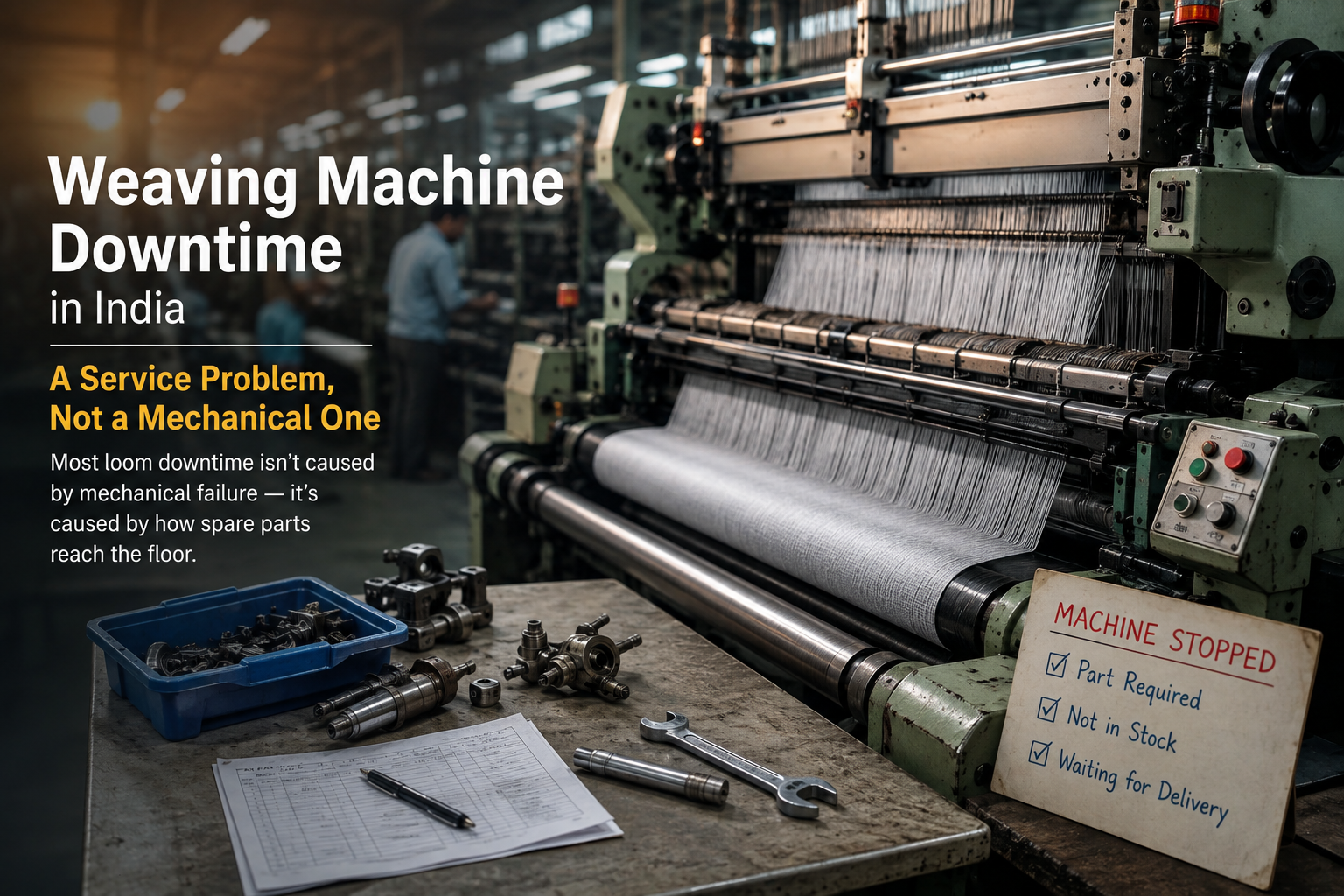
The Machine Is Not the Problem. The Day After Is.
There is a question I have sat with for years, usually on the floor of a weaving unit, watching a loom that has stopped running while its owner is on the phone.
By Nikunj Jagetia, Founder, Requip Digital Private Limited
There is a question I have sat with for years, usually on the floor of a weaving unit, watching a loom that has stopped running while its owner is on the phone. The machine is fine. It broke, yes. But the part that needs replacing — a nozzle assembly, a feeder unit — costs a few thousand rupees and weighs less than a kilogram. The machine is physically capable of running again within the hour. But it will not run again today. Maybe not tomorrow either. The machine is not the problem. The day after is.
What We Get Wrong About Downtime The industry frames downtime as a mechanical problem. A failure rate. An engineering challenge. We invest in higher-RPM looms, better cam systems, precision engineering. All of it matters. But it misses the real bottleneck. Roughly 80% of loom stops trace back to wear on air jets, grippers, and reeds — components that are well understood, predictable, and entirely replaceable. Top-performing mills run at 92% loom efficiency or higher, not because their machines are newer, but because they respond faster when something stops. The machinery is not the variable. The response time is. When I looked closely at how weaving clusters across India were actually experiencing downtime, the pattern was consistent. A machine stops. The dealer checks stock. The part is not local. It is in another city. Sometimes ordered from overseas, where complex European and Japanese machines carry supply lead times of 6 to 18 months for major components. The structure of most distribution models simply does not reward inventory risk at the local level. Stock sits at the national warehouse. The cluster waits. The result: a machine that could run is standing still. Not because of engineering. Because of geography. Because of how the supply chain was designed — not for the weaver's floor, but for the distributor's balance sheet.
The Thesis: Service Infrastructure Is the Real Edge The Indian textile machinery market is USD 1.14 billion, growing to USD 2.02 billion by 2033. That growth assumes the machines being sold will keep running. But the infrastructure to keep them running — stocked spares, trained engineers, fast response — has not grown at the same pace. The cost of getting this right is large and measurable. Manufacturers that move from reactive to preventive maintenance reduce unplanned downtime by 35 to 45% and cut maintenance costs by 10 to 25%. The preventive approach saves the equivalent of over Rs. 47 lakh per loom annually when accounting for both direct costs and lost production. For a mill running 20 looms, that is recoverable value sitting inside a service decision, not a machine purchase decision. The machine is a one-time cost. The downtime is a recurring one.
The Anti-Thesis: Does Local Stocking Actually Work? The counter-argument deserves a serious answer. Local spare parts stocking is expensive. India's textile sector includes 2.6 million power looms across dozens of OEM brands — Toyota, Tsudakoma, Picanol, Dornier, Sulzer — each with hundreds of unique components per model. No single distributor can reasonably stock every part for every machine at every cluster location. The inventory math does not work at that level of breadth. The counter-thesis goes further. Digital commerce platforms — IndiaMART, TradeIndia, direct Chinese suppliers — are narrowing the availability gap faster than traditional distribution ever could. The argument runs that the logistics problem is self-correcting. This is partly true. But it is not the whole picture. What digital platforms solve is availability at a price. What they do not solve is speed, accountability, or technical knowledge. When a weaver sources a nozzle assembly from a supplier 800 kilometres away, they still face the same question: who verifies the part, who installs it correctly, and who is accountable if the machine runs poorly after? The logistics gap is narrowing. The knowledge and accountability gap is not.
What This Means in Practice When I built Requip, I made a deliberate choice to build the service infrastructure before scaling distribution. Not because it was the faster route to revenue. Because it was the only route to a credible promise. That means stocking high-frequency, high-impact components — nozzle assemblies, feeders, cam parts, weft sensors — for airjet, waterjet, and rapier platforms. Not every part for every machine, but the parts that cause the most downtime when they fail and are the most expensive to wait on when they are not in stock. It means engineers who know the platforms. A 48-hour response standard we measure against actual service logs, not marketing copy. Because the job is no longer just replacing failed parts. It is protecting asset utilisation, supporting flexible manufacturing, and sustaining production confidence across increasingly complex machine ecosystems.
The Argument I Would Make to Every Weaver Reading This What is your cost of one week of downtime per loom per year? For a high-speed airjet running at 800 RPM on a 190cm width, one week of downtime is roughly 8,400 metres of lost output. That number repeats every time the machine stops and the part is not local. The machine purchase is a capital decision. The service model is a recurring profit-and-loss decision. Most weavers evaluate the first carefully and accept the second as given. It does not have to be given. Service infrastructure — machines sourced, verified, and supported through one relationship — is not a value-add. It is the actual product. We built Requip around that belief. Not in the machine. In the day after.
Nikunj Jagetia is the Founder of Requip Digital Private Limited, a B2B weaving machinery lifecycle platform operating across India's major textile clusters — Surat, Ichalkaranji, Kishangarh, Bhilwara, Ahmedabad, and Coimbatore. buy.sell.trust.Requip.