
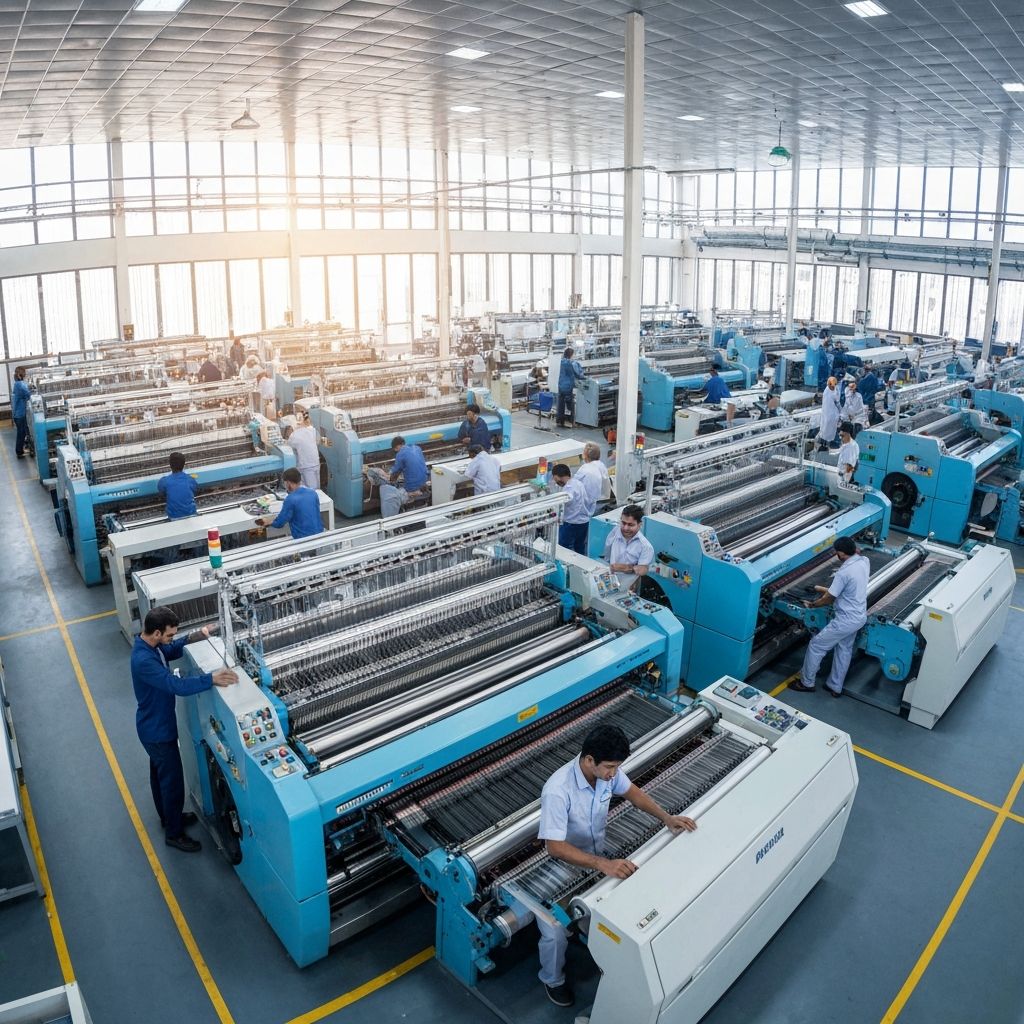
Indian Textile Market 2026: Trends, Challenges, and Opportunities in Weaving
A practical look at the trends, challenges, and opportunities shaping India's weaving industry in 2026.
By Requip
India’s weaving industry at a strategic crossroads
India’s textile industry in 2026 sits at a strategic crossroads. Domestic demand remains resilient, global buyers are diversifying supply chains, and policy-led infrastructure is pushing the industry toward larger, more efficient clusters.
At the same time, manufacturers are navigating cost pressures, compliance expectations, and the ongoing shift in fibre and fabric demand. The strongest opportunities belong to mills that improve uptime, quality consistency, and cost per metre through disciplined modernisation.
Where the market stands in 2026
India remains a major global player in textiles and apparel. Export performance continues to be influenced by global demand, category mix, and trade conditions. Integrated parks and cluster development can strengthen logistics, shared services, and access to skilled people over time.
Trends reshaping weaving in India
Automation moves from advantage to baseline
Weaving units are adopting controls, monitoring, and preventive maintenance practices that reduce manual intervention and improve consistency. These capabilities are becoming normal operating requirements rather than optional upgrades.
Fibre mix and fabric demand are evolving
Man-made fibres and new-age materials are becoming more important alongside natural fibres. This changes fabric construction choices, yarn handling requirements, and the loom configurations manufacturers prioritise.
Sustainability and compliance expectations keep rising
Buyers increasingly expect clearer reporting on waste, energy efficiency, traceability, and process discipline. Units that can demonstrate consistent controls are better placed to win and retain long-term orders.
Infrastructure becomes a competitive lever
Integrated parks and stronger manufacturing clusters can provide better logistics, shared services, and access to skilled workers.
Challenges weaving units are managing
- Power, compressed air, spare parts, and maintenance directly affect cost per metre.
- Quality variation becomes expensive as production scales.
- Export demand remains sensitive to trade conditions and global cycles.
- Automation changes workforce roles toward supervision, troubleshooting, and planned maintenance.
Where the opportunities are
Upgrade capacity without overstretching capital
Verified reconditioned machines can help manufacturers modernise capability while controlling upfront cost, particularly when machines come with professional inspection, installation, and support.
Improve consistency and uptime
Stable processes, calibration discipline, preventive maintenance, and faster access to parts reduce defects and protect output. In weaving, uptime is money.
How Requip helps
- 35-point machine inspection
- One-year warranty on eligible machines
- Professional installation support
- Annual service support
- Flexible finance coordination
Frequently asked questions
What is the biggest weaving trend in 2026?
Operational modernisation and automation, with equal focus on stable quality, predictable uptime, and energy discipline.
Are reconditioned weaving machines a good option?
Yes, when the machine is properly inspected, its condition is documented, and installation and after-sales support are available.
How can weaving units protect margins during export volatility?
Improve cost per metre, uptime stability, quality consistency, and buyer diversification.